
Columbia County Court Calendars Explained
No single date finder covers every court in Columbia County. The clerk's archive posts dated calendar files with titles. The case-information route lists settings inside case histories. Judge pages add their own calendar groups. A calendar entry shows the date, time, courtroom, judge, and setting type. It does not show every order or later change. Compare the newest calendar file with the docket. When the two conflict, call the clerk or ask at the counter. Magistrate, Probate, Juvenile, Grovetown, and Harlem each keep separate calendars. A Superior Court calendar never covers the whole county.
Columbia County Court Calendar Archive
The official clerk calendar archive is a dated list with page controls and Previous and Next navigation. Read more links lead to the calendar files themselves. The list runs 54 pages deep. Watch the filenames. Revised and duplicate versions appear, and the first result is not always the newest one. This archive records what the clerk published and when. It is not a search by party or case number. Narrow it by date and judge, then check the document against docket history.
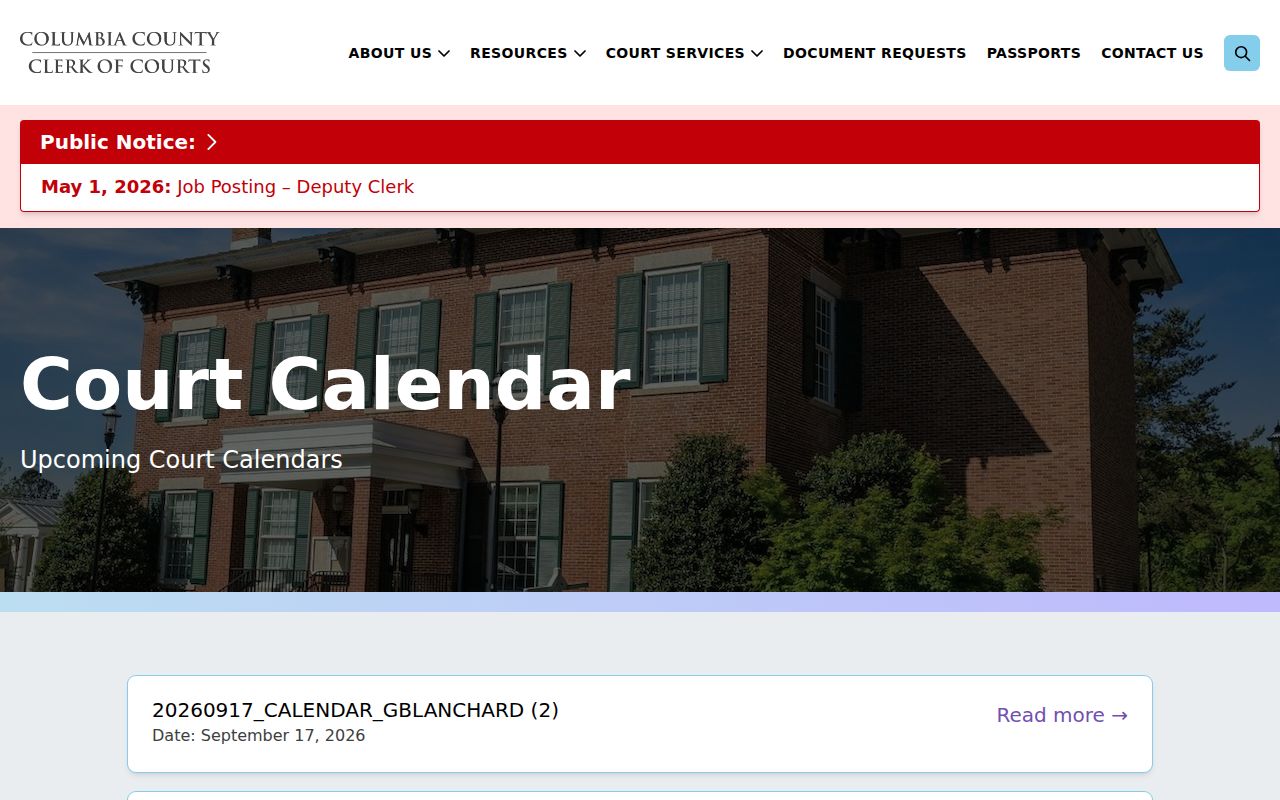
The archive page lays out its files in a simple list. That list helps you find a calendar by date, but a later revision or addendum may control the setting.
Older files stay in the archive, so note the date, judge, and title before you save anything. Note revised or addendum wording too. A posted calendar can point you to a setting, while the current docket or a call to the court office tells you whether it still stands.
Finding Your Court Date
Start at the Clerk case-information page. It links to the Columbia County public docket portal. Enter a case number if you have one. A party name, a judge name, or a CSE number can also pull up a Superior civil or criminal case. For a wider name-and-number search, turn to the Columbia County Case Lookup page. It collects those tools in one place.
- Choose the court level. Superior Court, Magistrate Court, Probate Court, Juvenile Court, and city municipal courts do not share one calendar.
- Search the clerk portal by case number, party name, judge name, or CSE number, then expand the result to read the proceeding history.
- Open the clerk’s dated calendar archive and identify the judge, calendar title, date, and any revised or addendum marker.
- Check the assigned judge’s public calendar page. Jolly, Fleming, and Blanchard publish separate material and use different calendar labels.
- Call the Clerk at 706-312-7139 or the relevant judge’s case manager when the docket and calendar disagree.
- Use the courthouse counter, public terminal, or a printed calendar when online access loops, omits an older case, or is unavailable.
- Remember that the Georgia Courts e-access directory is a provider directory, not a free statewide calendar search. Columbia Superior is mapped to PeachCourt, which uses a registered account.
Columbia County publishes no single calendar query by attorney, case number, and date. There is no countywide email reminder or remote-hearing link either. A printed daily calendar at the courthouse works as a practical fallback. Still, match it against the case history. Then confirm with the court office before you plan around it.
Columbia County Court Date Channels
Judge pages carry details the archive index lacks. Chief Judge Sheryl B. Jolly's page posts daily and criminal calendar material. Her judicial assistant can be reached at 706-312-7231. Her case manager is at 706-447-6733. Use those lines to confirm a public setting; they do not replace a docket entry.
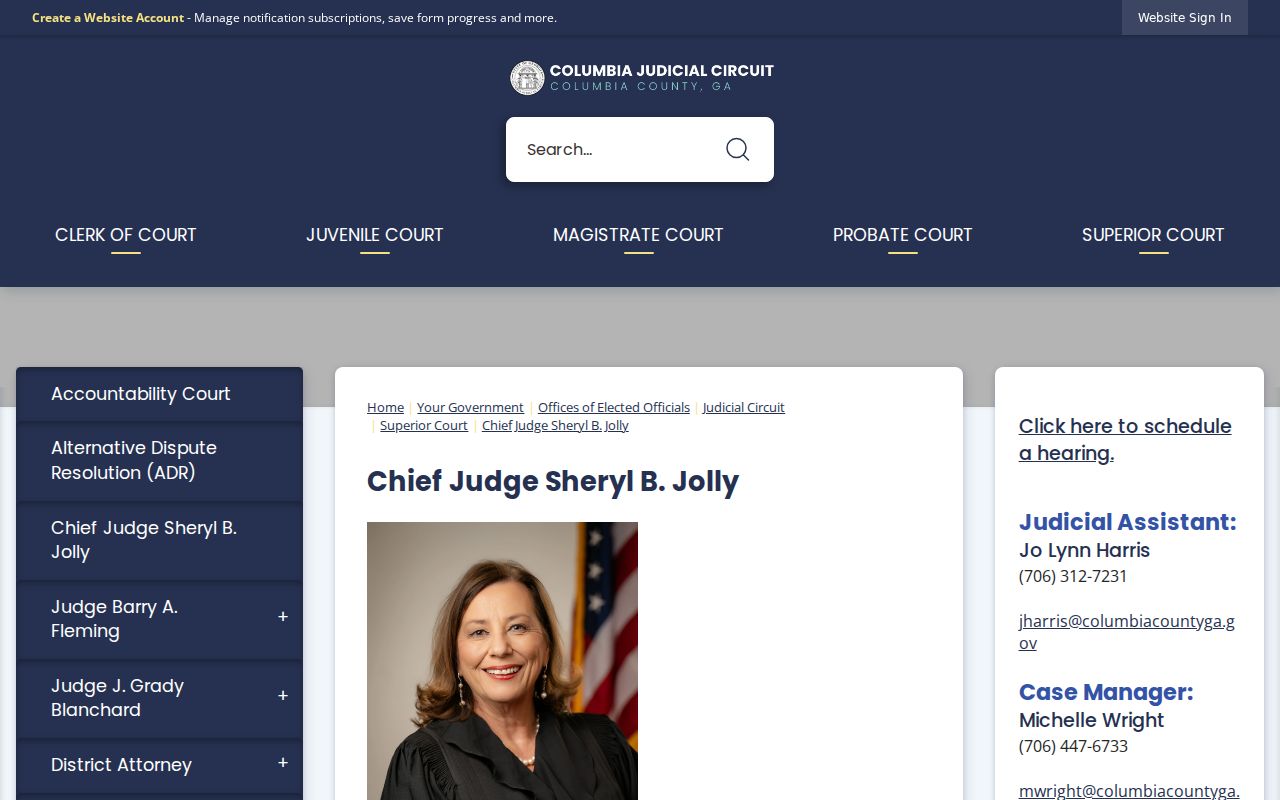
The judge page and the clerk archive can each show a different view of the same court day. Checking both is the safer habit.
Judge Sheryl B. Jolly
Judicial assistant: 706-312-7231
Case manager: 706-447-6733
Public daily and criminal calendar material is posted through the judge’s county page.
Judge Barry A. Fleming
Judicial assistant: 706-312-7356
Case manager: 706-447-7730
Weekly, motion, arraignment, revocation, sentencing, and trial labels appear on the calendar source.
Judge J. Grady Blanchard
Judicial assistant: 706-312-7355
Case manager: 706-447-6732
Criminal, civil jury, calendar-call, revocation, sentencing, and arraignment labels appear on the calendar source.
For a general court-calendar question, the Clerk's records line at 706-312-7139 is the fallback. The county locations page lists the Justice Center and other court destinations. Use it when your date belongs to a court outside the Superior calendar.
How to Read a Court Setting
One setting line is a compact schedule, not an outcome. The date and time tell you when the court calendared the matter. The judge and courtroom tell you where the session should happen. The setting type names the work. It may be arraignment, motion, sentencing, revocation, calendar call, or a trial grouping.
| Date | The scheduled calendar date. Check a newer revised file or docket entry before relying on an older date. |
|---|---|
| Time | The published session or setting time. Jolly examples include 9:00 a.m., 10:30 a.m., and 2:00 p.m.; use the actual file for the case. |
| Courtroom | The room named in the calendar or the judge’s default notice. A listed exception controls. |
| Judge | The judge or court group responsible for the setting. Confirm when a case moves or a calendar is revised. |
| Setting type | Arraignment, motion, bond, sentencing, revocation, calendar call, jury trial, bench trial, weekly calendar, or civil jury trial. |
"Calendar call" covers readiness and scheduling work, not a verdict. "Motion and bond" is a hearing block, not a trial. "Sentencing" marks the disposition stage. "Jury trial" and "bench trial" mark a trial setting. The actual order or disposition lives in the docket itself.
Columbia County Courtroom Defaults
Courtroom assignments follow the judge. The Judge Barry A. Fleming calendar source places settings in Courtroom 4 unless noted. Judge J. Grady Blanchard's calendar source lists Courtroom 1 unless noted. An entry can always state an exception. Check the current file rather than trusting the default.
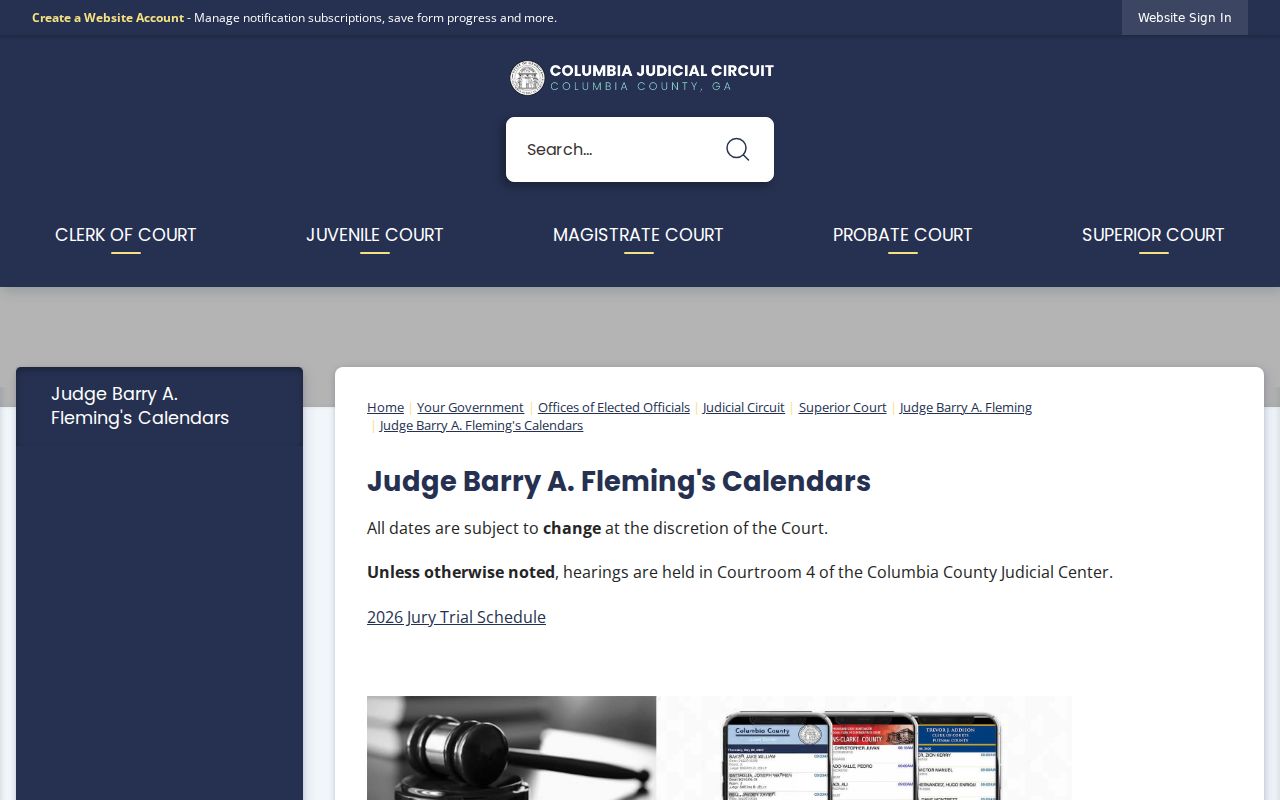
A judge-calendar source shows the courtroom default for that judge's settings. That is how you tell a default from a case-specific exception.
| Judge or source | Published calendar detail | Confirmation step |
|---|---|---|
| Barry A. Fleming | Courtroom 4 unless the calendar notes another room; dates may change. | Use the latest Fleming file and call the clerk or case manager if unclear. |
| J. Grady Blanchard | Courtroom 1 unless the calendar notes another room; dates may change. | Use the latest Blanchard file and check revised or addendum material. |
| Sheryl B. Jolly | Daily and criminal calendar material is posted, but no single universal courtroom appears in the static page text. | Read the current calendar and confirm with the judge’s office. |
The county's court locations source names the Justice Center and other court facilities. A Superior courtroom default does not carry over to Magistrate, Probate, Juvenile, Grovetown, or Harlem matters.
Continuances, Resets, and Cancellations
Schedules in Columbia County shift, and the docket tells you how. A continuance or reset simply moves a setting. When an entry vanishes from the calendar, the reason is not always clear. It may have been resolved. It may have been moved, or pushed to a later list. A later docket entry can settle the question. So can a revised calendar file, an addendum, or a call to the court office.
The clerk archive and the Fleming and Blanchard calendar pages carry the same warning. Dates change. An old PDF sitting in the archive is not the final word. Check the file date. Check the calendar title, and any revised or addendum text before trusting what you see.
If a setting disappears, call 706-312-7139 or the assigned judge's case manager. Magistrate, Probate, Juvenile, and municipal cases go to those courts directly. A countywide calendar is a convenience, not the office that controls the case.
Columbia County Calendar Addenda
Addenda are supplemental calendar lists, and a revised file can correct or replace an earlier posting. The Blanchard calendar page posts revised revocation, calendar-call addendum, arraignment, sentencing, jury-trial, and civil-jury lists. Fleming's source carries misdemeanor calendar-call addenda and trial-week call material as well.
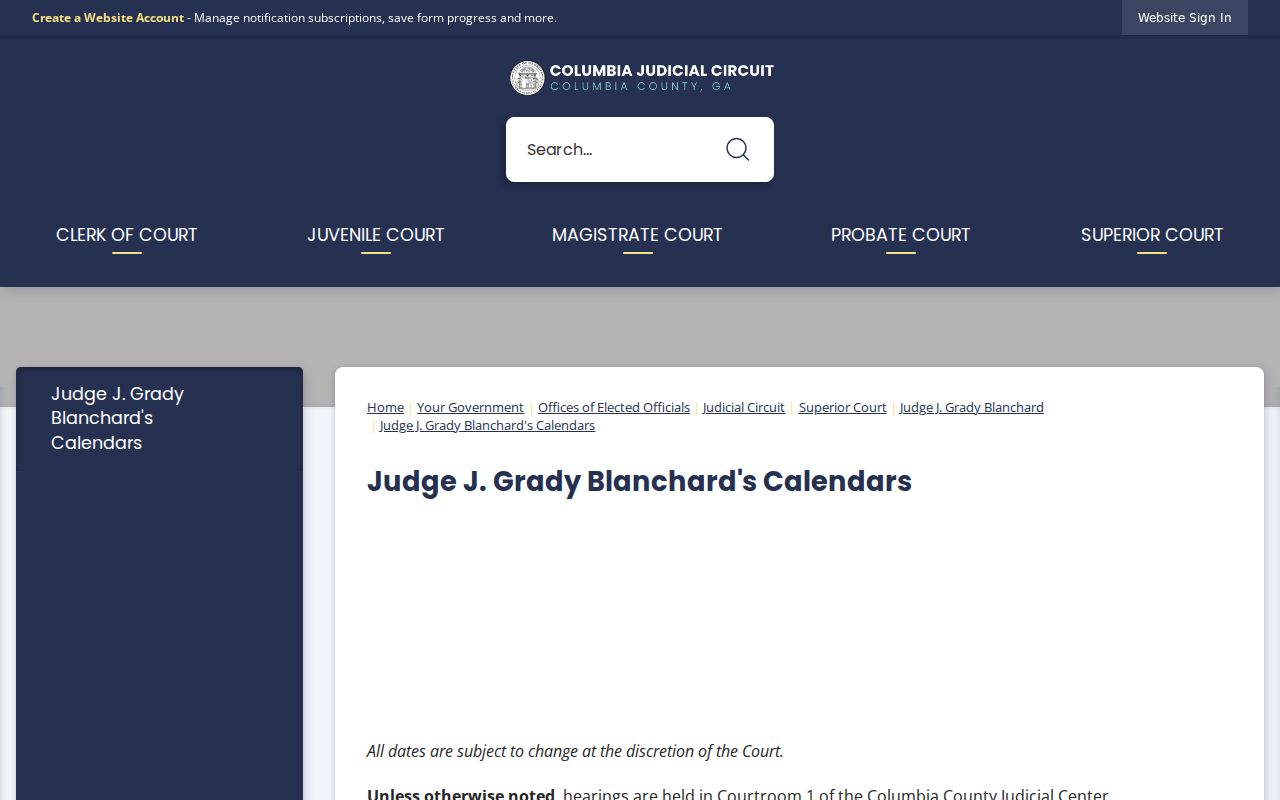
This is a public calendar source. Read it alongside the date and the case history. A label names the kind of list; it does not tell you the outcome of any individual case.
- Arraignment
- A criminal setting for the formal charge, plea, and scheduling stage.
- Motion and bond
- A hearing block for motions or bond issues, not a trial result.
- Calendar call
- A readiness or scheduling grouping for trial or other court work.
- Revocation hearing
- A setting about alleged probation-violation or revocation status.
- Sentencing
- A disposition-stage setting for the sentence entry and related conditions.
- Addendum or revised calendar
- A supplemental or corrected list that may control over the earlier posting.
Before you rely on a setting, write down the calendar title, judge, date, time, courtroom, and any revision marker. That note helps the clerk or case manager pull up the same file.
If You Miss a Court Setting
Miss a court setting in Columbia County? Act fast. Check the case history first. Then check the most recent judge or clerk calendar. Then call the clerk or the judge's case manager. A missing calendar entry proves nothing. It does not mean the case was dismissed or that you can ignore it.
What happens next turns on the court and the type of setting. Any order the judge entered matters too. A criminal docket can produce a bench warrant after a missed appearance. Civil, Probate, Magistrate, Juvenile, and municipal matters each follow their own response rules. Ask the responsible court which entry or order controls and what procedure applies.
Missed a setting? A missed court date can create a serious case-management problem, and a later docket entry may record a warrant, reset, or other response.
Call the clerk at 706-312-7139 or the assigned judge’s case manager as soon as possible, and keep the case number ready.
If represented, contact counsel as well, but verify the active date with the court office responsible for the case.
Columbia County Court Recording Requests
An open courtroom is not a green light to record. Columbia County has device rules. The Rule 22 order and request form is the way to seek permission for a judicial proceeding. The form asks for the case number, parties, courtroom, proceeding, device, intended use, dates, personnel, your signature, firm or position, and judge approval.
The current Superior Court source links visitor and device guidance effective January 1, 2026. Check that notice before bringing equipment. A public calendar or an open door is not recording permission; the approval is.
Rule 22 stands apart from a date search or a docket copy. Use the case number and setting details, then follow the court's process. Judge approval counts even for an open proceeding.